

History Lab
The series
At History Lab we’ve got some good stories to tell
But we are interested in much more than just the story. Instead of an academic or other expert telling you what to think, History Lab wants to draw you in to the investigative process. It wants you to come along with us as we try to make sense of the traces the past leaves in the present. You’ll find that this can sometimes be confusing and frustrating: records are patchy, evidence is destroyed and a lot of the time people disagree about what happened and what it means.
But more often than not, trying to make sense of the traces of the past is also pretty exciting. Things are not always what they seem. Aren’t we always in the process of finding that out? Come and join us, as together we try and make sense of the big and little questions all around us.
Can colonial depictions of Indigenous people tell us anything useful about the past?
How do Indigenous people today feel about these enduring images?
Unsettling Portraits is a three-part series exploring the history of portraiture and colonialism, alongside contemporary First Nations responses.
Indigenous artists and historians in Australia, the Pacific and North America discuss the practice of colonial portraiture, including Daniel Browning, Jo Rey, Alice Te Punga Somerville, Gordon Henry and Joseph Pierce.
And you’ll hear about the ways in which contemporary artists like Daniel Boyd, Michel Tuffery, and the late Destiny Deacon have turned back the gaze on settlers with their art.
Join acclaimed historians Kate Fullagar and Mike McDonnell as they and their collaborators wrestle with the portraits of our colonial past in History Lab Season 6: Unsettling Portraits.
Podcast playlist
EPISODE 3
3. Faces Today: Indigenous Artists Return the Gaze
Colonial portraits have long dictated how Indigenous people were seen. But Indigenous artists continue to challenge that power. Through satire, reinterpretation, and resistance, they’re using art to question history—and reshape the future.
In this episode, historians Kate Fullagar and Mike McDonnell speak with contemporary Indigenous artists who are confronting the legacy of empire. Michel Tuffery, a New Zealand-based artist of Samoan, Tahitian, and Cook Islander heritage, reimagines Captain Cook through the eyes of those he encountered. Daniel Boyd, one of Australia’s most celebrated contemporary artists, subverts colonial iconography, turning figures like Cook into symbols of piracy and exploitation. Daniel Browning, an Aboriginal journalist and art critic, reflects on the power—and the lies—embedded in colonial paintings.
Can art break the cycle of representation, or does it always carry the weight of its past? Join us on this final episode of Unsettling Portraits to find out.
Episode images
This representation of Captain James Cook belongs to a narrative series titled ‘First Contact’. The series retells the story of James Cook’s Pacific voyages from a Polynesian perspective, focusing on the profound way in which Cook himself was altered through his experiences in the Pacific. His identity is altered, as marked by hibiscus flowers, hei-tiki around his neck and his Polynesian features. The name Cookie is not only a more familiar name for Captain Cook but it is also a nickname for a Cook Islander. (Curator’s comments)
By Michel Tuffery. 2009. British Museum.
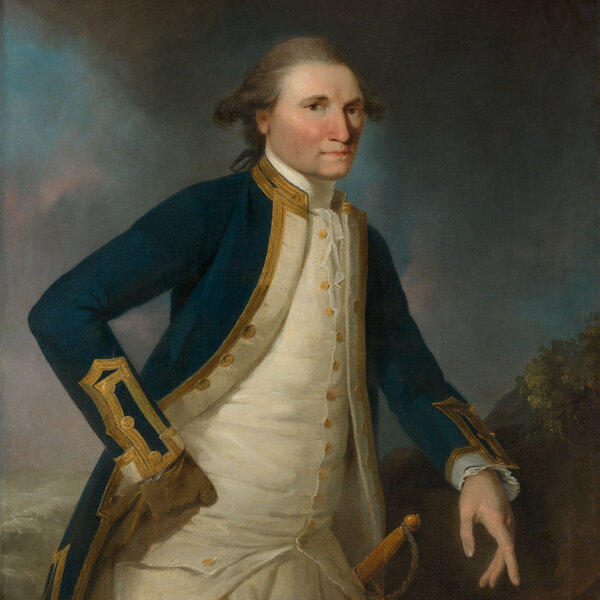
Portrait of Captain James Cook RN
By John Webber, 1782. National Portrait Gallery Australia
By Daniel Boyd, Kudjla/Gangalu/Kuku Yalanji/Jagara/Wangerriburra/Bandjalung peoples, 2005. National Gallery of Australia.
Nannultera, a young Poonindie cricketer
By J.M. Crossland, 1854. National Gallery of Australia.
Portrait – Eva Johnson, writer
By Destiny Deacon, 1994. Queensland Art Gallery.
Guests
Michel Tuffery, a New Zealand-based artist of Samoan, Rarotongan, and Ma’ohi Tahitian heritage, creates work that bridges environmental, cultural, and historical divides. Known for his role as a connector between people and places, he engages communities through exhibitions, research, and residencies across the Pacific and beyond. A passionate educator, he shares his kaupapa and knowledge with young people through workshops in New Zealand and abroad. Appointed a Member of the New Zealand Order of Merit in 2008 for his contributions to art, he continues to enrich communities through his creative practice.
Daniel Boyd, one of Australia’s leading artists, is a Kudjala, Ghungalu, Wangerriburra, Wakka Wakka, Gubbi Gubbi, Kuku Yalanji, Bundjalung, and Yuggera man with ni-Vanuatu heritage. Based on Gadigal/Wangal Country, his work reinterprets Eurocentric histories through historic photographs, art references, and personal narratives. He first gained recognition in 2005 with his No Beard series, challenging colonial iconography, and later developed his signature ‘lens’ technique—clear dots that fragment the image plane, exploring perception and hidden histories. In 2014, he became the first Aboriginal and Torres Strait Islander artist to win the Bulgari Art Prize, further cementing his impact on contemporary art.
Daniel Browning is an award-winning Bundjalung and Kullilli writer, journalist, and radio broadcaster. Currently serving as the ABC’s Editor of Indigenous Radio, he presents The Art Show and Arts in 30 podcasts. His debut book, Close to the Subject: Selected Works, was hailed as “an outstanding contribution to arts journalism,” winning the 2024 Prime Minister’s Literary Award for Non-Fiction and the Indigenous Writing Prize at the Victorian Premier’s Literary Awards and was also shortlisted for the NSW Premier’s Literary Awards. Beyond his literary achievements, Browning is a sound artist and documentary maker, known for curating Blak Box, an award-winning sound pavilion amplifying First Nations voices. He is also a widely published freelance writer on arts and culture, with a particular focus on Australian Indigenous art.
To cite this episode
Fullagar, K (researcher and host), Freyne, C (producer), McDonnell, M (researcher and host), Thomas, H (producer) (2025), ‘Unsettling Portraits’ Episode 3. In History Lab by Impact Studios, https://impactstudios.edu.au/podcasts/history-lab/s6/ and 10.5281/zenodo.15086322


EPISODE 2
2. Facing Off: From Botany Bay to Aotearoa
In this episode, historians Kate Fullagar and Mike McDonnell revisit Bennelong’s portraits to examine how colonial art encountered Indigenous identity. Indigenous scholar Jo Rey, a Dharug woman, challenges these depictions, questioning their accuracy and impact.
The conversation then expands to the Pacific, where Māori scholar Alice Te Punga Somerville discusses the story of Tupaia, a Polynesian navigator and artist who traveled with Captain Cook. His illustrations of first contact tell a different story—one of Indigenous agency, not just European discovery.
What do we see when we look at these portraits today? And more importantly, what do they obscure? Join us on Unsettling Portraits to find out.
Episode images
By James Neagle, 1798. Courtesy National Library of Australia.
Australian Aborigines paddling bark canoes and spear fishing
DRAWINGS, in Indian ink, illustrative of Capt. Cook’s first voyage, 1768 -1770.
This may record the fishing party observed by Joseph Banks at Botany Bay on 26 April 1770.
By A. Buchan, John F. Miller, and others. Courtesy British Library.
A Maori bartering a crayfish with an English naval officer
DRAWINGS, in Indian ink, illustrative of Capt. Cook’s first voyage, 1768 -1770, chiefly relating to Otaheite and New Zealand.
By A. Buchan, John F. Miller, and others. Courtesy British Library.
Guests
Jo Rey is a Dharug scholar and Macquarie University Fellow for Indigenous Researchers in the Department of Indigenous Studies. Her research focuses on Dharug Ngurra/Country, which spans much of the Sydney metropolitan area, examining key cultural sites, including Shaw’s Creek Aboriginal Place and the Blacktown Native Institution. Building on her doctoral research on Dharug cultural continuity, her post-doctoral work explores Indigenous cultural agency through the concept of ‘Living Law’—a framework of sustainable relationality based on Recognition, Respect, Rights, Responsibility, and Reciprocity.
Alice Te Punga Somerville (Māori – Te Āti Awa, Taranaki) , professor of English Language and Literatures at the University of British Columbia, is a poet, scholar, and irredentist whose work explores Indigenous connections, colonial histories, and the power of language. She is the author of Once Were Pacific: Māori Connections to Oceania, 250 Ways to Write an Essay about Captain Cook, and the poetry collection Always Italicise: How to Write While Colonised, each challenging dominant narratives and centering Indigenous perspectives.
To cite this episode
Fullagar, K (researcher and host), Freyne, C (producer), McDonnell, M (researcher and host), Thomas, H (producer) (2025), ‘Unsettling Portraits’ Episode 2. In History Lab by Impact Studios, https://impactstudios.edu.au/podcasts/history-lab/s6/ and 10.5281/zenodo.15086322
EPISODE 1
1. Facing Empire: A Long History of Representing Others
Bennelong, a Wangal man of the Eora nation, was among the first Aboriginal people to travel to Europe and return. As a crucial interlocutor between his people and the British colonists, he navigated two worlds but the way he was depicted in colonial portraits raises complex questions. In one, he appears in traditional body paint. In another, years later, he is dressed in European clothing, his identity seemingly reshaped for a colonial gaze. Do these portraits tell us more about Bennelong or the people who painted him?
Portraiture has long been a tool of empire, used to categorize, control, and mythologize. But can these images also reveal Indigenous agency? In this first episode, historians Kate Fullagar and Michael McDonnell visit the National Portrait Gallery to examine Bennelong’s likeness and trace a broader history of representation. They are joined by Anishinaabe writer Gordon Henry, who reflects on 17th-century depictions of Indigenous North Americans, and Cherokee scholar Joseph Pierce, who challenges the sanitized portrait of Cherokee diplomat Ostenaco.
Who really controls the stories that portraits tell? And how do these images continue to shape our understanding of Indigenous identity today? Join us on Unsettling Portraits to find out.
Episode Images
Drawing 41 from the Watling Collection titled ‘Native name Ben-nel-long, as painted when angry after Botany Bay Colebee was wounded.’ By Thomas Watling c 1790. Courtesy Natural History Museum London.
Portrait of a Famous One-eyed Man
By Louis Nicolas, 1675. Codex Canadensis, page 14. Courtesy Gilcrease Museum, Tulsa, Oklahoma USA.
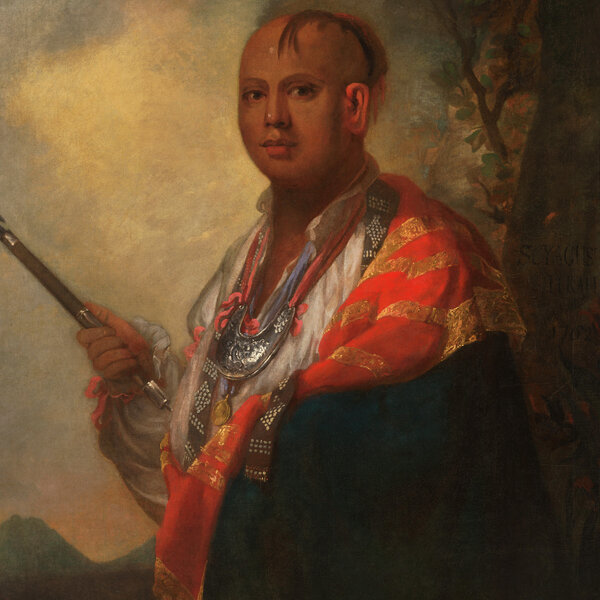
Portrait of Syacust Ukah, Cherokee Chief
By Joshua Reynolds, 1762. Courtesy Gilcrease Museum, Tulsa, Oklahoma USA.
Hosts
Kate Fullagar, professor of history at the Australian Catholic University and Vice President of the Australian Historical Association, specializes in eighteenth-century world history, particularly the British Empire and Indigenous resistance. In her role at the AHA, she advocates for truth-telling in Australian historiography, working to integrate Indigenous perspectives and confront colonial legacies. Through works like Bennelong & Phillip, she engages both academic and general audiences, challenging traditional narratives.
Michael McDonnell, professor of Early American History at the University of Sydney, is currently working on several research projects with collaborators, including studies on comparative Indigenous experiences of empire, the American Revolution’s role in Black American life, and memoirs of lower-class Revolutionary War veterans. His work highlights the value of history in fostering diverse perspectives and uncovering new insights about both the past and present.
Guests
Gordon Henry is a member of the White Earth Anishinaabe Nation in Minnesota, USA and was professor of English at Michigan State University for 29 years. A widely published essayist, poet and fiction writer, he won the American Book Award for is novel The Light People. His creative work focuses on American Indian survival and adaptability, offering different Indigenous ways of relating to American history.
Joseph Pierce is a citizen of the Cherokee Nation and associate professor in the department of Hispanic Languages and Literature at Stony Brook University. His research focuses on the intersections of kinship, gender, sexuality, and race in Latin America, as well as culture, queer and Indigenous studies. Along with SJ Norman (Koori, Wiradjuri descent) he is co-curator of the performance series and indigenous-led gathering space Knowledge of Wounds.
To cite this episode
Fullagar, K (researcher and host), Freyne, C (producer), McDonnell, M (researcher and host), Thomas, H (producer) (2025), ‘Unsettling Portraits’ Episode 1. In History Lab by Impact Studios, https://impactstudios.edu.au/podcasts/history-lab/s6/ and 10.5281/zenodo.15086322

EPISODE 0
Introducing: Unsettling Portraits
Can colonial depictions of Indigenous people tell us anything useful about the past?
How do Indigenous people today feel about these enduring images?
Unsettling Portraits is a three-part series exploring the history of portraiture and colonialism, alongside contemporary First Nations responses.
Indigenous artists and historians in Australia, the Pacific and North America discuss the practice of colonial portraiture, including Daniel Browning, Jo Rey, Alice Te Punga Somerville, Gordon Henry and Joseph Pierce.
And you’ll hear about the ways in which contemporary artists like Daniel Boyd, Michel Tuffery, and the late Destiny Deacon have turned back the gaze on settlers with their art.
Join acclaimed historians Kate Fullagar (Australian Catholic University) and Mike McDonnell (Sydney University) as they wrestle with portraits of our colonial past in History Lab Season 6: Unsettling Portraits.
