

Impact Talks at UTS
Season 1
Episode 3
Technology, ethics and responsible AI development with Signal’s Meredith Whittaker
 5.0
1h 3m
5.0
1h 3m


- Synopsis
Synopsis
How do technology, ethics, and responsible AI development intersect and how do they impact on our shared future?
Meredith Whittaker (keynote speaker) has over 17 years of experience in tech, spanning industry, academia, and government. Before joining Signal as President, she was the Minderoo Research Professor at NYU, and served as the Faculty Director of the AI Now Institute which she co-founded. Her research and scholarly work helped shape global AI policy and shift the public narrative on AI to better recognize the surveillance business practices and concentration of industrial resources that modern AI requires.
Professor Edward Santow (moderator) is the Co-Founder and Director – Policy & Governance at the Human Technology Institute, and is leading a number of major initiatives to promote human-centered artificial intelligence. From 2016-2021, Ed was Australia’s Human Rights Commissioner, where he led the Commission’s work on artificial intelligence & new technology; refugees and migration; human rights issues affecting LGBTI people; national security; and implementing the Optional Protocol to the Convention Against Torture (OPCAT).
Associate Professor Ramona Vijeyarasa (panel speaker) is Director of the Juris Doctor Program at UTS, and is one of the leading global scholars on gender-responsive legislation. Ramona is Chief Investigator behind the Gender Legislative Index (GLI), an online tool that uses human evaluators and machine learning to assess whether domestic laws meet global women’s rights standards.
Professor Peta Wyeth (panel speaker) is Dean, Faculty of Engineering and Information Technology at UTS. Peta is internationally recognised in the field of Human-Computer Interaction (HCI) and is at the forefront of research into emerging tangible, mobile and embedded technology for education and entertainment. Peta is at the forefront of research into emerging tangible, mobile and embedded technology for education and entertainment. Her research career is typified by interdisciplinary collaborations addressing real world problems.
Podcast playlist
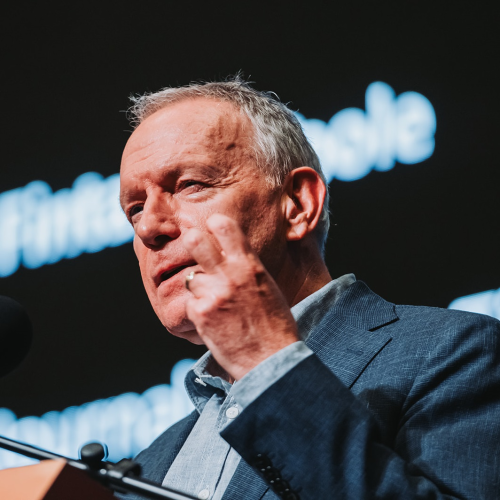
EPISODE 6
Fintan O’Toole on The Perils of Self-Pity: Democracy and Identity in the Age of Trump
In this extraordinary ‘year of elections’, voters in many parts of the world are being asked, not just to choose between parties and candidates, but to decide whether they still believe in the democratic system itself?
Fintan O’Toole asks why systems and values that had been taken for granted for so long are now in such peril. He argues that a central part of the problem is the distortion of the sense of victimhood.
There are profound injustices but the rising far-right movements have little interest in remedying them, Instead, they take the language of resistance to oppression and distort it into a self-pity in which even those who are highly privileged can feel sorry for themselves — and imagine themselves to be victims of some other group.
The result is a politics of tribalism in which defeating the Other is much more important than gaining anything tangible.
How can we combat this drift into tribalism and restore the sense of common purpose without which democracy becomes hollow?
Fintan O’Toole (keynote speaker) is one of Ireland’s leading political and cultural commentators. Fintan is a columnist with The Irish Times and Leonard L. Milberg visiting lecturer in Irish Letters at Princeton University.
He is the winner of both the Orwell Prize and the European Press Prize, and the author of more than 25 books. His most recent book, We Don’t Know Ourselves: A Personal History of Ireland Since 1958, was named 2021 Book of the Year by the Irish Book Awards and as one of the ten best books of 2022 by the New York Times.
Dr Anna Funder (moderator) is an award-winning author and UTS Luminary. Anna is the author of Stasiland, All That I Am, Wifedom: Mrs Orwell’s Invisible Life and the novella The Girl With the Dogs. Anna’s novel Wifedom was a Sunday Times Bestseller and New York Times Notable Book of 2023.
Roy Green AM (moderator) is an Emeritus Professor and Special Innovation Advisor at UTS. Roy is on the Board of CSIRO and the SmartSat CRC, and he is a member of the CSU Council and Australian Design Council and Committee for Sydney Economics Advisory Council.
The Vice-Chancellor’s Democracy Forum (VCDF) is UTS’s premier public lecture series. This is the second of the 2024 forum series, held on 26 September 2024.
Each year, the Vice-Chancellor invites significant thinkers across various fields to engage in open dialogue on topics crucial to today’s society and its advancement.
Impact Talks at UTS is produced by UTS Impact Studios, with sound engineering by Alison Zhuang.


EPISODE 5
Cultivating an anti-ractist culture on campus
At UTS, our diversity is our strength, with half of our staff and students born overseas and over 40 per cent coming from non-English language backgrounds. Despite this, universities can still be places where racist conduct and practices occur.
Race Discrimination Commissioner Giridharan Sivaraman delivers a compelling keynote on the higher education sector’s role in combating racism, and discusses the Australian Human Rights Commission’s historic anti-racism study at universities.
Following his keynote, he joins Larissa Behrendt, Kylie Readman, Salma Elmubasher, Glen Babington, Michael Blumenstein and Elaine Laforteza (moderator) to explore how UTS is driving anti-racism efforts and the necessary steps universities must take to foster an environment of pride and belonging for all.
Giridharan Sivaraman is Australia’s Race Discrimination Commissioner whose role is to promote equality between people of different backgrounds, conduct research and educational programs to combat racial discrimination and protect people from unfair treatment or vilification based on their race, colour, descent, visa status, or national or ethnic origin.
Distinguished Professor Larissa Behrendt AO is a Laureate Fellow at the Jumbunna Institute for Indigenous Education and Research at UTS. Larissa has a legal background with a strong track record in the areas of Indigenous law, policy, creative arts, education and research.
Salma Elmubasher is the Ethnocultural Officer at the Ethnocultural Collective, a part of the UTS Students Association, advocating for spaces for UTS students who identify as Black, Indigenous or as a Person of Colour to connect and organise together.
Professor Kylie Readman is UTS’s Deputy Vice-Chancellor and Vice-President (Education and Students). She is responsible for overseeing UTS’s key priorities in teaching, learning and the student experience.
Glen Babington is UTS’s Chief Operating Officer and Vice-President and is responsible for the university’s finance, marketing, communications, property, IT, HR and legal functions, as well as the Data Analytics and Insights Unit.
Professor Michael Blumenstein is currently the Deputy Dean (Research and Innovation) in the UTS Faculty of Engineering & IT. UTS’s largest and most culturally diverse faculty.
This public lecture was presented by UTS Centre for Social Justice and Inclusion on 21 August 2024, as part of the Centre’s Inclusion Festival.
Impact Talks at UTS is produced by UTS Impact Studios, with sound engineering by Alison Zhuang.
EPISODE 4
How the state’s industrial policy can tackle climate change and inequality with Dr Joseph Stiglitz
What is the role of the state in tackling climate change, boosting productivity, and creating the jobs of the future through industrial policy?
Professor Stiglitz (keynote speaker) is a Nobel Laureate, former World Bank Chief Economist, best-selling author and professor at Columbia University.
Professor Kathy Walsh (moderator) is a Finance Professor and the Associate Dean (Research and Innovation) at the UTS Business School and has a critical role in fostering a vibrant research culture of rigorous, relevant and impactful research.
This sold out public lecture was presented by UTS Business School on 30 July 2024.
Impact Talks at UTS is produced by UTS Impact Studios, with sound engineering by Alison Zhuang.
