

History Lab
Season 6
Episode 2
2. Facing Off: From Botany Bay to Aotearoa
 5.0
38 MIN
5.0
38 MIN


- Synopsis
- Credits
- Transcript
In this episode, historians Kate Fullagar and Mike McDonnell revisit Bennelong’s portraits to examine how colonial art encountered Indigenous identity. Indigenous scholar Jo Rey, a Dharug woman, challenges these depictions, questioning their accuracy and impact.
The conversation then expands to the Pacific, where Māori scholar Alice Te Punga Somerville discusses the story of Tupaia, a Polynesian navigator and artist who traveled with Captain Cook. His illustrations of first contact tell a different story—one of Indigenous agency, not just European discovery.
What do we see when we look at these portraits today? And more importantly, what do they obscure? Join us on Unsettling Portraits to find out.
Episode images
Ben-nel-long
By the Port Jackson Painter, c. 1790. Watling, Thomas. Courtesy of the Natural History Museum, London.
By James Neagle, 1798. Courtesy National Library of Australia.
Australian Aborigines paddling bark canoes and spear fishing
DRAWINGS, in Indian ink, illustrative of Capt. Cook’s first voyage, 1768 -1770.
This may record the fishing party observed by Joseph Banks at Botany Bay on 26 April 1770.
By A. Buchan, John F. Miller, and others. Courtesy British Library.
A Maori bartering a crayfish with an English naval officer
DRAWINGS, in Indian ink, illustrative of Capt. Cook’s first voyage, 1768 -1770, chiefly relating to Otaheite and New Zealand.
By A. Buchan, John F. Miller, and others. Courtesy British Library.
Hosts
Professor Kate Fullagar is an historian at the Australian Catholic University and Professor Michael McDonnell is an historian at Sydney University.
Guests
Jo Rey is a Dharug scholar and Macquarie University Fellow for Indigenous Researchers in the Department of Indigenous Studies. Her research focuses on Dharug Ngurra/Country, which spans much of the Sydney metropolitan area, examining key cultural sites, including Shaw’s Creek Aboriginal Place and the Blacktown Native Institution. Building on her doctoral research on Dharug cultural continuity, her post-doctoral work explores Indigenous cultural agency through the concept of ‘Living Law’—a framework of sustainable relationality based on Recognition, Respect, Rights, Responsibility, and Reciprocity.
Alice Te Punga Somerville (Māori – Te Āti Awa, Taranaki) , professor of English Language and Literatures at the University of British Columbia, is a poet, scholar, and irredentist whose work explores Indigenous connections, colonial histories, and the power of language. She is the author of Once Were Pacific: Māori Connections to Oceania, 250 Ways to Write an Essay about Captain Cook, and the poetry collection Always Italicise: How to Write While Colonised, each challenging dominant narratives and centering Indigenous perspectives.
To cite this episode
Fullagar, K (researcher and host), Freyne, C (producer), McDonnell, M (researcher and host), Thomas, H (producer) (2025), ‘Unsettling Portraits’ Episode 2. In History Lab by Impact Studios, https://impactstudios.edu.au/podcasts/history-lab/s6/ and 10.5281/zenodo.15086322
Credits
Producers: Catherine Freyne and Helene Thomas.
Story Editor: Siobhan McHugh
Sound Engineer: Martin Peralta
Additional production and editorial support: Jane Curtis, Britta Jorgensen and Celine Teo-Blockey
Additional tile design and podcast artwork: Alexandra Morris
Executive Producer: Sarah Gilbert
History Lab S6, Unsettling Portraits. Ep2: Facing Off: From Botany Bay to Aotearoa
To cite this episode
Fullagar, K (researcher and host), Freyne, C (producer), McDonnell, M (researcher and host), Thomas, H (producer) (2025), ‘Unsettling Portraits’ Episode 2. In History Lab by Impact Studios, https://impactstudios.edu.au/podcasts/history-lab/s6/ and 10.5281/zenodo.15086322
JOSEPH PIERCE: This painting sanitises something savage from a European perspective about this person’s visage, his countenance.
GORDON HENRY: There’s sort of a naturalist edge to this. There’s sort of a cataloguing of the world, looking at animals, looking at fishing, looking at the natives.
JO REY: I mean, I look at that image and for me, it’s ridiculous. Sorry, but you know – it’s just – ugh!
MIKE MCDONNELL: This is Unsettling Portraits.
KATE FULLAGAR: Season 6 of History Lab.
MIKE MCDONNELL: A three-part podcast series that looks closely at the history of portraiture, colonialism, and First Nations responses.
KATE FULLAGAR: I’m Kate Fullagar.
MIKE MCDONNELL: And I’m Mike McDonnell.
We are both historians of Empire, and its encounter with Indigenous peoples in the past.
GH: And I think it would be good for me to take these images to different tribal communities. And have a conversation with them around them, and see what they’re seeing it. Just like you’re asking me.
ALICE TE PUNGA SOMERVILLE: It may be a little bit unsettling for everybody.
MT: We’re smart enough as human beings to deal with this.
MIKE MCDONNELL: Episode 2: Facing Off.
KATE FULLAGAR: From Botany Bay to Aotearoa.
MIKE MCDONNELL: Kate, what is this music? What are we listening to?
KATE FULLAGAR: This is a recording of a song obviously done recently, but it’s a song that we know Bennelong and his compatriot who went with him to Britain, Yemmerrawanne, sang to their London hosts in 1793.
We even know the venue in which they sang it, it was on Mount Street in Mayfair. They sang it to the person who put them up while they were living in Mayfair, William Waterhouse.
Amongst the audience was a Welsh folklorist who took down the notation of the song. And it found its way all the way to two Indigenous singers, Clarence Slockee and Matthew Doyle, who performed this song in 2010, I think it was, near Sydney Opera House.
So it’s our closest thing that we have to Bennelong’s voice while he was in London.
MIKE MCDONNELL: So it’s interesting, Kate. Certainly when I came to Sydney, I was made aware of Bennelong. But never really got to know anything beyond a very kind of static flat image. So I just wondered if you could maybe talk a little bit about Bennelong’s presence, but also that absence.
KATE FULLAGAR: Well, Bennelong, particularly for Sydney people, is a person that most people would know. I mean, you’d see his name everywhere in Sydney.
Bennelong was a Wangal man, which is sort of from today’s Balmain area. And the reason why he’s famous in the history books is because he was the first important Indigenous interlocutor for the colonists.
But I think he’s more than just a go-between: I argue in my work on Bennelong that he represents someone who maintained an Indigenous life and maintained his own personal sovereignty through invasion.
In some ways, you know, looking at the two sides of him, and actually trying to move away from the static, flat, as you called it, image of Bennelong: you can actually see the dynamism of his life when we compare these two portraits that we started looking at in the first episode.
[Picture This: Bennelong 1790 reprise] 03:55
Picture this.
KATE FULLAGAR: This first one here shows Bennelong in 1790. He’s only known the colonists for about one year at this point.
It’s a picture of a man.
Of this person framed in a circle.
He’s front-on.
He’s got very dark skin, curly hair, brown eyes.
He’s looking straight at whoever is doing the artwork.
He has painting on his body, so two kind of semi-circles starting from his sternum that go up over his shoulders, he’s then got another white stripe that goes across the bridge of his nose.
KATE FULLAGAR: It’s actually titled ‘Bennelong When Angry’. He doesn’t come across, I don’t think, particularly furious, but he certainly comes across a little bit wary.
And we can see he’s represented in his Eora painted self-presentation, with his eyes definitely on the colonial game and not taking his eyes off it.
Only three years later, once Bennelong had visited London, here’s another representation based on a sketch of someone who was in England with him, another British person, of course. And the difference is so stark, isn’t it?
[Picture This: Bennelong 1798] 05:13
Picture this.
I’m seeing a person extracted out of an environment and put onto a blank piece of paper.
He’s got very fine western clothes on.
Wearing a uniform or outfit that seems to belong to the colonists of Australia.
And in the background there’s shields and there’s clubs and stone axes and spears.
The way that it’s designed…
…Side-on profile…
… In front of these weapons.
Items that look like they’ve been made of wood or rocks or animal teeth.
And what the artist has done is intentional, right? It’s like, why isn’t the figure out with the weapons? Why are they placed like that?
I think it’s Bennelong. And I think it’s when the British took him back to England.
It’s almost like the aftermath of the event.
Yeah. I think that’s definitely what this painting was trying to get, is that we’ve gone through this process of colonising this place where all these objects are. We’ve taken one of these men, and we’ve changed them into more or less an Englishman, and he’s put all of these savage indicators of his culture behind him.
[Bennelong in London] 06.34
MIKE MCDONNELL: And what was he doing in London, Kate?
KATE FULLAGAR: Bennelong, as we know, had this reasonably close political diplomatic relationship with Arthur Phillip, the governor of New South Wales. Their relationship was quite a good one – I wouldn’t go so far as to say they were friends – but an important founding relationship for colonial history.
When Phillip went home after his five-year tenure as governor, he took Bennelong with him. And Bennelong was a willing traveller. So they depart Sydney Cove at the end of 1792 and arrive in London in 1793.
MIKE MCDONNELL: So you’re saying that Bennelong really wanted to go to London?
KATE FULLAGAR: Definitely. There’s no sign that he was coerced into being there.
Bennelong, we know, had been trying to help ease potential violence that could occur in the colony for the last several years.
I think he went to London because he wanted to extend that diplomatic exercise. It was his way of furthering his mastery of this culture, which he realised by this stage at least, was not going to go away any time soon.
When he’s in London, he gets sketched by, we think, his landlord, William Waterhouse. And that’s the image that goes on to serve as the basis for this later portrait.
Bennelong stays there for two years. It’s really as a guest of the British government, and I think he enjoyed it for the first year or so.
As I mentioned, he brought with him a younger kinsman called Yemmerrawanne, who unfortunately after that first year, sickens and dies, and he’s buried over in England.
It’s pretty obvious that from about that point, Bennelong is starting to lose his interest in the whole exercise.
He comes home by 1795. After 1795, increasingly, Bennelong distances himself from colonial politics altogether.
MIKE MCDONNELL: Kate, we learned a lot in the first episode from Joseph Pierce and Gordon Henry. For Bennelong, who might we look to?
KATE FULLAGAR: Yes. Bennelong was part of a wider Sydney Aboriginal group that spoke the language Dharug. So I thought we might turn to our colleague, Jo Rey.
JO REY: Hello Mike, I’m Jo.
MIKE MCDONNELL: Lovely to meet you.
JO REY: Oh, hi, Kate.
KATE FULLAGAR: Hello! I so appreciate you doing this.
JO REY: My pleasure.
KATE FULLAGAR: Jo Rey is an Indigenous scholar from Macquarie University and a Dharug woman.
MIKE MCDONNELL: I guess the best way into this maybe is to ask you a little bit about your own background, and what Bennelong means to you personally?
JO REY: Well first of all, as I’m on Dharug country, at Gai-maragal country, I’d like to pay my respects to elders past, present, and emerging, and recognise that they always have been and always will be caring for country.
I was born and raised on Wallumedegal country, which is just across the river from where I’m speaking. My ancestry on my mother’s mother’s side goes through to the Dharug connection. And it’s on my mother’s father’s side that I am connected into James Squires. He was a convict, and was a dear friend of Bennelong’s.
So my sense of connection to Bennelong’s story is very much around the relationship between him and James Squires, and also the fact that Bennelong travelled to London.
He was an emissary from his people. But my understanding from the colonial perspective was that he was the so-called example, you know, of the colonised native.
And so, those two pictures that you’ve provided me with.
The one in 1790, he’s painted up for ceremony. The implication of what was written was that this paint-up was for war. But I’ve checked with my mob and that’s actually ceremonial because it was white paint. If it was going to be for war, it would be red paint.
But certainly, the 1798 picture where he’s dressed in all his colonial finery: that would have been required of him when he went to London. And so that 1798 image was him conforming to whatever the rules of London were at that time. But that didn’t necessarily express who he was.
KATE FULLAGAR: Yeah.
JO REY: I guess I connect to Bennelong’s story with my own story of being an expat living outside of my language, my culture in Europe for seven years, and understanding what that expatriate experience is like.
KATE FULLAGAR: Yeah, that’s beautifully put. I’ve been thinking about Bennelong for such a long time. But to think of him as an expat – it’s a nice way of thinking about that revision and that recasting of Bennelong.
JO REY: Yes.
And then I link it back to his return to his people and how the first thing he did was take off all his clothes and re-join his mob. And for me, that indicates that his desire to return to his place of belonging and the culture, his own culture was much stronger than any sense of, ‘Oh, I’m the civilised man now.’
But having said that, he was never going to be the same person that returned as he was before he left.
KATE FULLAGAR: It’s just so moving to think about the full life story of Bennelong.
MIKE MCDONNELL: And Jo, I just wanted to come back to the 1790 painting. You’ve already kind of begun to upend our ideas about that. You’ve mentioned that you shared it with others. I’m just wondering about your insights about it.
JO REY: Well, I look at that as I think most people would look at it given its context of 1790, and this painting would have been done by a white, colonising individual. And so for me, what I’m seeing is the interpretation of the white colonising individual who’s painted it.
I just look at it and take it with a grain of salt. I don’t reckon it indicates too much. Except to say that he was obviously a slim person; he was obviously young; he was obviously painted up. It’s not a caricature, but it’s not very representative of a reality either, in my opinion.
But you know, having said that, there’s a greater context of connection for Aboriginal people in my opinion, to the 1790 image, just because it reflects our culture rather than the 1798 one, which reflects the values of colonisers.
We don’t value, I mean, you know, I look at that 1798 image and, and for me it’s ridiculous. Sorry, but that’s –
KATE FULLAGAR: No, absolutely.
JO REY: You know.
MIKE MCDONNELL: Yeah.
JO REY: Yeah. It’s, it’s just, ugh.
MIKE MCDONNELL: Yeah. I was going to ask you, Jo – you’ve talked a little bit about the 1798 image and in some sense the, the kind of the fabrication of both images by the colonisers.
And I just, you know, sometimes I get frustrated and wonder, what’s the value of these kind of images at all? And I just wondered what your sense of that might be. You know, is it good that we have these images, or not?
JO REY: Ah, that’s an interesting question, you see, because that goes into the collection and the power of collection and the problem of collection and the reliance by Western society on collection for truth.
You know, I struggle with this notion that the only truth can be written truth or visual truth as interpreted by others, with no respect for oral tradition.
And that wipes out 65, 000 years of culture that obviously has been carried forward through oral form and through images on rock faces and things like this that have been delivered.
But this type of, you know, where a painting or something like that is put into a museum and therefore that is the valid truth, this is what whitefellas have declared is important, therefore it’s important. And if it’s not in that form or those forms, then it doesn’t count.
And so for me, I’m all about caring for country and caring for country in the city. And so the eradication of our culture through the demolition of landscapes for housing, and that human-centric approach to life – which came from 1788. Because prior to that, it wasn’t there. It was about human beings being within a network of species, not on top of it.
And so for me, this type of evidence has to be challenged if we’re going to have proper truth telling. And in the context that we’ve got today on this continent, so-called Australia, there’s real significance in challenging all these notions of what is valid and what isn’t valid.
So, that’s my, I hope that answers your question for you.
MIKE MCDONNELL: Thanks so much, yeah. And actually, it really echoes, it’s wonderful to hear you say that because it really echoes Gordon Henry, our Anishinaabe guest. He was talking about portraits in North America and how they’re isolated. You know, so Bennelong’s isolated here from country. And he was talking about how the portrait doesn’t really speak to him because it’s been taken out of that kind of country context.
JO REY: Yep.
MIKE MCDONNELL: And I think you’re saying effectively, in many ways, the same thing…
JO REY: Yes.
MIKE MCDONNELL:…in a different way.
JO REY: That’s right.
MIKE MCDONNELL: So it’s wonderful. It’s really interesting to hear that.
JO REY: Oh, good.
So yanama budyari gumada, walk with good spirit. Thank you very much. And I hope we cross paths again another time.
KATE FULLAGAR: I hope so too.
MIKE MCDONNELL: Thank you, Jo.
JO REY: Thank you. Yanu.
[Bennelong wrap] 17:22
MIKE MCDONNELL: So Kate, Jo Rey is making a really important point, right? Because a lot of what we see with the portraits that we’ve been looking at and with the texts and pieces of evidence that we find in the archives, we’re only getting a little glimpse of a moment when Indigenous peoples came into contact with Europeans.
But Bennelong’s story kind of reminds us that there’s a huge amount that took place outside, beyond the ken of Europeans and beyond the written record of Europeans.
That Indigenous peoples had their own lives, they had their own histories, that they had their own conflicts with other peoples that we don’t know a lot about.
KATE FULLAGAR: That’s right. That’s why it’s particularly ironic to me that this second portrait of Bennelong when he’s dressed up like a European gentleman and seems so kind of overpowered by English assimilationary forces is at the exact moment when he actually himself, starts turning away from Britain. And does survive the turn away. And very successfully lives back amongst his Eora and refuses assimilation completely.
MIKE MCDONNELL: So Kate, where are we going next?
KATE FULLAGAR: So now we’re moving back in time. We’re moving back just twenty years and we’re staying in the Sydney harbour region. We’re moving though, from the Sydney Harbour southern shore of Bennelong’s land and moving down to what the colonists called Botany Bay or Gweagal land.
Twenty years earlier, James Cook’s Endeavour ship is in the harbour. It’s not Phillip’s first fleet, but Cook’s exploratory Endeavour ship. And he’s arriving from the east from Aotearoa waters.
I think what few people realise is that he carried on board this ship a Pacific Islander called Tupaia, who turned out not only to be a star navigator who helped Cook through his voyages, actually, all the way from Tahiti, but also an artist.
And fortunately, we have ten pictures that Tupaia produced, that reside in the British Library.
ALICE TE PUNGA SOMERVILLE: Tupaia – you know, the things that I’m going to say about Tupaia are coming from my perspective is a Maori person from Aotearoa, from New Zealand.
KATE FULLAGAR: This is our good friend Alice Te Punga Somerville.
ALICE TE PUNGA SOMERVILLE: Te Punga without the ‘gh’.
KATE FULLAGAR: Oh, Te Punga, sorry.
Alice is currently in Canada.
Thanks so much for coming here, Alice.
ALICE TE PUNGA SOMERVILLE: Kia ora. It’s really good to be in conversation with you both.
KATE FULLAGAR: So we’ve just been turning towards the art of Tupaia. We have about ten images that – well, that survive anyway – that he did on this Endeavour voyage.
Do you want to tell us a little bit about who Tupaia was?
ALICE TE PUNGA SOMERVILLE: Absolutely. So Tupaia was from Ra’iatea in French Polynesia, or as Chantal Spitz would have us understand it, French-occupied Polynesia.
And he was an important figure in the story that Maori tell of Cook’s initial voyage to New Zealand.
So even though that story has been told often as this kind of white ship meeting these brown people, in fact, Tupaia was on board. He was on board because he was a really skilled navigator, a knowledge holder, a trained religious person, you know.
It seems like a lot of the Europeans who met him who left written records are pretty clear that they’re really impressed by this guy.
And so he ended up coming into my world, the New Zealand Maori world, 1769, not actually to the side of the North Island that I come from – so again, it’s sort of not my story – he came to the east coast.
But he’s a really important figure for us understanding the way that the initial contacts between Europeans and the region actually also were reconnections between Indigenous peoples of the region.
MIKE MCDONNELL: So I guess that gives us a little bit of a background of why Tupaia ended up in Kamay, in what Australians call Botany Bay. What do you know of that? And what was he doing there?
ALICE TE PUNGA SOMERVILLE: So he ended up traveling with Cook on his voyage. He went through a number of parts of the Pacific. Because so many of the islands, at least in the part of the Pacific that I come from, Polynesia, so many of the languages are so closely spoken, he was actually able to be useful, not just to get there, but then also to serve as a kind of translator or communications, you know, advisor all the way through.
My understanding is once they got to what’s now known as Australia, he actually found that his vast facility and the range of Polynesian languages was no help to him there.
And so it became a really important point of understanding, there were points of Indigenous connection between all the places that Cook had been with him up to that point, and that that connection did not extend to Australia.
And so perhaps a kind of moment of understanding that Indigenous Australia comes from a really, really different kind of deep history than the rest of us newbies from the Pacific.
KATE FULLAGAR: Yeah, that’s fascinating, isn’t it? And it’s fascinating that because he had a history of connection with other Indigenous peoples through the Pacific, when he gets to Kamay and he finds that linguistically there’s no longer connection, perhaps he finds a connection through his own graphic representations.
Before we turn to the Pacific images of Tupaia, do you have any initial thoughts about this wonderful picture of three Kamaygal fisher people?
ALICE TE PUNGA SOMERVILLE: Yeah, I think one of the points of connection that Tupaia can see, obviously, despite linguistic and cultural and other kinds of difference that would have been quite apparent, and maybe a little bit unsettling for everybody – because up to that point, both he and Cook and all those guys had been kind of bumping into places and yet being able to make themselves known.
And yet in that moment, one of the things I like about the fact that the thing that has survived is of fisher-people is there’s a point of connection there in terms of activity.
And so even if the language is different, the people are different, the cultural protocol no doubt felt really suddenly quite unfamiliar and sort of almost unsettlingly so, there’s this point of connection of like, ‘Oh, okay, these people are fishing’. This is an important part, obviously, of the way that we all practice our cultures as well as feed ourselves through the region.
So I think it’s interesting that this depiction is of a familiar activity, which plays up perhaps more connection, rather than, ‘This is something which is unfamiliar to us’.
Even if there are specificities to the, you know, the shape of the canoe, or what have you.
MIKE MCDONNELL: And I guess Alice, moving backwards in time now before the voyage to Australia, we’ve also got an image, Tupaia’s image of the Maori man with a crayfish.
This looks like an exchange of some sort.
Picture this.
Like a peaceful exchange.
I get the feeling this is Aotearoa and a Maori person dealing with a white person.
They both seem to be the same height or at the same level as each other.
In between the two there is a lobster.
The figure on the right seems to have maybe some kind of cloth.
Or maybe it’s some sort of document.
It’s faint. He’s got his hands extended out, I’m not sure, maybe taking the lobster, maybe giving the lobster.
There’s definitely some sort of exchange going on.
The other thing to note about the image is that it doesn’t look like it’s done by a professional artist, it looks like a kind of, a bit more of a lay person’s sketch of this taking place.
ALICE TE PUNGA SOMERVILLE: So that image is totally iconic.
I think it was Anne Salmond’s book, The Trial of the Cannibal Dog, was the first time that I came into connection with this image, where she kind of shared that this was in fact produced by an Indigenous person. So up to that point, it kind of circulated as an image that some random bloke on the ship had made.
For me, as a Maori person with an interest in our connections with the region, that already reframes the image completely. Okay. So the first image produced that represents Maori engagement with non-Maori and with Europe is produced by another Indigenous person from elsewhere.
Okay. The other thing that it tells me and that I used to share with my students when I taught always in New Zealand, particularly in Pacific studies is: as long as there have been white people in New Zealand, there have been Pacific Islanders or Indigenous people to the Pacific, right?
So, you know, for me, that image is such a beautiful interruption to a kind of false narrative of the state as being kind of Maori and European, and then these other random Pacific migrants came at some point later, right?
So, there’s something kind of really beautiful about that anyway.
KATE FULLAGAR: Yep.
ALICE TE PUNGA SOMERVILLE: Turns out there’s another layer. And the other layer is that what you see in the image is a moment of exchange, and it’s a moment of exchange between the European person holding out either some white fabric, cloth, or paper, and we’re like, ‘Ooh, this is all very European, stands in for European culture and Englishness and so on’, and the Maori person is holding out a crayfish, a coda, right?
Okay. Raw materials exchanged for produced materials, cloth and paper as sign of a certain kind of civilisation; the rawness of the lobster.
Okay. We can see why people love this image, right? It stands in for everything.
But it turns out that the thing that the European person is actually offering for exchange in that moment, that Tupaia captures, that I’m pretty sure no one else would have thought to capture is that what was being extended was actually a piece of tapa, a piece of the cloth that’s made from paper mulberry, a kind of tree that’s found all around the region and that some people would know as tapa, masi, hiapo, siapo, kapa, natu.
So this thing that the European is extending is actually Tahitian tapa, right? And probably Tahitian because that’s what they just picked up from Tahiti when they were cruising through and also picking up Tupaia, but also because one of the aspects that I understand of their tapa is that it’s often unadorned or undyed, and so that kind of very white tapa – which led everyone to go, ‘Oh, it must be some white cotton from a mill in London’ or something like that.
So again, for me, that’s about a reconnection point, actually. That it’s through this European technology, through the ship, through the arrival of Europeans, that the actual exchange that’s occurred and that Tupaia thought was important to depict was this kind of reconnection of Maori with tapa.
Because unfortunately for me, my ancestors picked quite a cold southern spot in the Pacific. So what that means is that actually the paper mulberry doesn’t really grow there, except in a couple of regions. And so we didn’t have these lengths of tapa that they could produce in places like Tahiti, Ra’iatea, and so on.
And so for Maori, it was like, ‘Holy moly, our great great greats weren’t exaggerating when they said these little shred bits of tapa actually come in whole sheets back in our ancestral homeland.’
Okay. And then there’s just one more layer, okay, I’m going to add one more layer. And the additional layer is that, in theory, the European dude who’s involved in the exchange, I think it might have been Banks.
KATE FULLAGAR: That’s Joseph Banks, he was the naturalist on the Endeavour with Cook.
ALICE TE PUNGA SOMERVILLE: So anyway, turns out, I was reading something and Banks was actually asked about this later in his life – ‘Oh, do you remember that moment on the beach, the moment of exchange that was represented in this way?’ He was like, ‘Oh yes, yes, no, I do remember that. Yep, we exchanged some crayfish for some nails.’ Yeah?
And so even later in his own life, he was unable to accurately recall that moment of exchange and instead kind of was already accidentally, unconsciously in the process of rewriting the significance of the reconnection of the Pacific part of the exchange by assuming that Maori would be interested in acquiring European goods rather than acquiring tapa.
MIKE MCDONNELL: Wow. That’s an amazing story. I love the idea that Tupaia was capturing this moment of significance between Pacific peoples and the Maori rather than Europeans and the Maori.
ALICE TE PUNGA SOMERVILLE: Absolutely. It’s kind of like he’s making a snapshot for home. Like, ‘Hey, it got here in one piece to our people!’, you know, rather than kind of going, ‘Oh look, these Maori people are being drawn into the capitalist network of the coloniser from England’, you know. Like it sort of beautifully, beautifully repositions what’s kind of happening in these moments that get so overwritten.
And that’s why I kind of really like the Banks misremembering as well. Like even the guy who was actually there, misremembers it.
So no wonder 250 years later we’re still like, ‘I don’t know, it was probably something like nails or cotton.’
KATE FULLAGAR: Yeah, that’s right. Yeah.
So I guess I have just one final question then. A lot of scholars have thought that both of these representations, well, all of the ten Tupaia images that survive from the Endeavour voyage look like he studied European forms of representation and kind of appropriated them in these imagery.
Do you have any thoughts about that? Do you think that maybe it is relevant at all that it looks to Europeans now that it looks like a European style? Maybe that’s actually not the way that we should approach it.
ALICE TE PUNGA SOMERVILLE: Yeah. It’s an intriguing thought. I probably have a few thoughts about that. One would be, given that the things that have remained in ways that remain accessible to us, are things that have been collected and stored by Europeans, it seems likely to me that Europeans doing that collection and storing would be like, ‘Oh, this is a good one. Looks a bit like ours.’
KATE FULLAGAR: Yep.
ALICE TE PUNGA SOMERVILLE: It’s entirely possible in my imaginary that Tupaia may have produced many more texts than this, and maybe some of them looked a little less like they were engaging with those European artistic traditions.
KATE FULLAGAR: Yes.
ALICE TE PUNGA SOMERVILLE: So I think there’s kind of a quite pragmatic archives question here and kind of what, what and who and what sorts of things and, you know.
If the question we’re asking is about appropriation, I think, on the one hand, appropriation feels inappropriate because appropriation has a connotation of a kind of power imbalance, where the person who is more powerful is able to take something and render it for their own purposes. And I’m not sure that the less powerful person gets to appropriate.
On the other hand, maybe it’s kind of fun to sometimes take the opportunity to put ourselves in those moments and not overwrite them too much with what we know about what happened next. And maybe it is a kind of appropriation. After all, these were just some kind of incompetent European sailors who didn’t know how to get around the region that he knew so well. So maybe it’s kind of nice to flip it on its head like that.
I also think – I don’t know a lot about Ra’iatean culture – but one of the things that I am constantly in awe of is the capacity for our highly trained knowledge keepers and knowledge holders to not just demonstrate with proficiency our own kind of ways of doing things, but to, with a real curiosity and from a sense of cultural security, engage and learn about cultural forms, including material artistic cultural forms from other Indigenous communities.
So to me, I wonder if it also speaks to Tupaia’s own training and significance as someone who’s already kind of an intellectual person, already used to kind of having the cultural confidence and the curiosity in kind of learning this new way. I mean, you spend a lot of time on a boat when you’re going somewhere. He probably had time to learn and to be trained.
And I think it speaks to his capacity – and I’m just being really careful here, not kind of condescendingly saying like, ‘How interesting that a native person would be that clever’, because that would be racist to say like, ‘Oh, I can’t believe it, he’s not stupid after all’ – but instead to kind of speak to this as maybe a continuation of his proficiency in other cultural forms.
KATE FULLAGAR: Yeah, that’s what I think too.
ALICE TE PUNGA SOMERVILLE: Yeah.
MIKE MCDONNELL: Thank you, Alice.
ALICE TE PUNGA SOMERVILLE: Thank you, guys.
KATE FULLAGAR: That’s fantastic, Alice.
ALICE TE PUNGA SOMERVILLE: Sweet as.
[Episode wrap] 34:21
KATE FULLAGAR: So, this late 18th century era, as we’ve been talking about Mike, really comes across as like kind of a turning point, doesn’t it, in our history?
MIKE MCDONNELL: Yeah it’s, you know, we often think of the 18th century as a moment of imperial expansion, of movement of Europeans, of European conquest. But I think what we’ve discovered here is that really, Indigenous mobilities and movement are really important parts of the stories that we’ve been looking at.
If you think about even the Odawa, we know that the Odawa in North America interacted on a grand scale across the Lakes. We know that the Anishinaabe were on the move. And then we’ve got Ostenaco in Cherokee country, moving within North America, but also traveling to London, followed by Bennelong.
KATE FULLAGAR: Yeah, and here’s Tupaia traversing the whole Pacific Ocean.
MIKE MCDONNELL: Yeah.
So, Kate, we’ve had a look at Tupaia, this Pacific Islander who’s moving with Cook and Europeans and depicting what he sees and thinking about what he sees and wanting to represent it.
And I guess in our next episode, we’re going to look at a few more Aboriginal and Pacific Island artists.
KATE FULLAGAR: That’s right. Really seeing the legacy of a tradition started by Tupaia.
There’s an array, particularly in this country, in Australia, of Indigenous artists grappling with the tradition of portraiture, but also particularly with early modern times, 17th and 18th centuries.
MIKE MCDONNELL: Yeah. I think we as historians, we have a tendency to look backwards, but maybe, by looking at Indigenous artists today, we can find a different way of viewing these portraits.
KATE FULLAGAR: Oh, definitely.
MIKE MCDONNELL: So, join us in Episode 3, when we’ll meet some terrific contemporary Aboriginal and Pacific artists who have engaged with the colonial encounter in their work and who continue to unsettle the imperial fantasy of conquest.
Podcast playlist
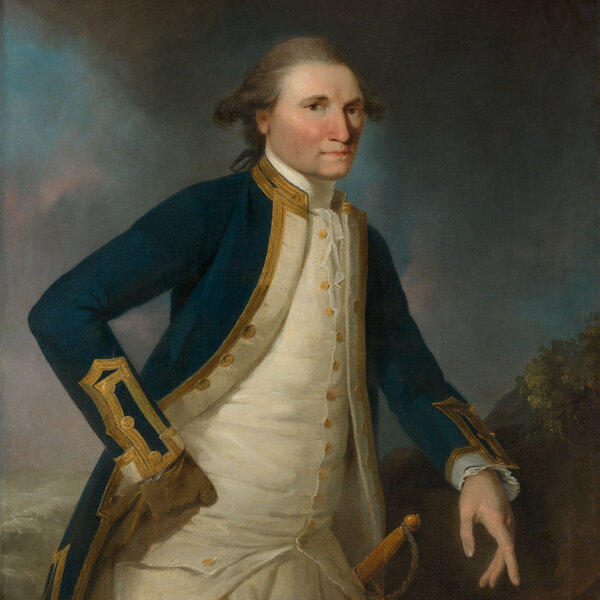
EPISODE 3
3. Faces Today: Indigenous Artists Return the Gaze
Colonial portraits have long dictated how Indigenous people were seen. But Indigenous artists continue to challenge that power. Through satire, reinterpretation, and resistance, they’re using art to question history—and reshape the future.
In this episode, historians Kate Fullagar and Mike McDonnell speak with contemporary Indigenous artists who are confronting the legacy of empire. Michel Tuffery, a New Zealand-based artist of Samoan, Tahitian, and Cook Islander heritage, reimagines Captain Cook through the eyes of those he encountered. Daniel Boyd, one of Australia’s most celebrated contemporary artists, subverts colonial iconography, turning figures like Cook into symbols of piracy and exploitation. Daniel Browning, an Aboriginal journalist and art critic, reflects on the power—and the lies—embedded in colonial paintings.
Can art break the cycle of representation, or does it always carry the weight of its past? Join us on this final episode of Unsettling Portraits to find out.
Episode images
This representation of Captain James Cook belongs to a narrative series titled ‘First Contact’. The series retells the story of James Cook’s Pacific voyages from a Polynesian perspective, focusing on the profound way in which Cook himself was altered through his experiences in the Pacific. His identity is altered, as marked by hibiscus flowers, hei-tiki around his neck and his Polynesian features. The name Cookie is not only a more familiar name for Captain Cook but it is also a nickname for a Cook Islander. (Curator’s comments)
By Michel Tuffery. 2009. British Museum.
Portrait of Captain James Cook RN
By John Webber, 1782. National Portrait Gallery Australia
By Daniel Boyd, Kudjla/Gangalu/Kuku Yalanji/Jagara/Wangerriburra/Bandjalung peoples, 2005. National Gallery of Australia.
Nannultera, a young Poonindie cricketer
By J.M. Crossland, 1854. National Gallery of Australia.
Portrait – Eva Johnson, writer
By Destiny Deacon, 1994. Queensland Art Gallery.
Guests
Michel Tuffery, a New Zealand-based artist of Samoan, Rarotongan, and Ma’ohi Tahitian heritage, creates work that bridges environmental, cultural, and historical divides. Known for his role as a connector between people and places, he engages communities through exhibitions, research, and residencies across the Pacific and beyond. A passionate educator, he shares his kaupapa and knowledge with young people through workshops in New Zealand and abroad. Appointed a Member of the New Zealand Order of Merit in 2008 for his contributions to art, he continues to enrich communities through his creative practice.
Daniel Boyd, one of Australia’s leading artists, is a Kudjala, Ghungalu, Wangerriburra, Wakka Wakka, Gubbi Gubbi, Kuku Yalanji, Bundjalung, and Yuggera man with ni-Vanuatu heritage. Based on Gadigal/Wangal Country, his work reinterprets Eurocentric histories through historic photographs, art references, and personal narratives. He first gained recognition in 2005 with his No Beard series, challenging colonial iconography, and later developed his signature ‘lens’ technique—clear dots that fragment the image plane, exploring perception and hidden histories. In 2014, he became the first Aboriginal and Torres Strait Islander artist to win the Bulgari Art Prize, further cementing his impact on contemporary art.
Daniel Browning is an award-winning Bundjalung and Kullilli writer, journalist, and radio broadcaster. Currently serving as the ABC’s Editor of Indigenous Radio, he presents The Art Show and Arts in 30 podcasts. His debut book, Close to the Subject: Selected Works, was hailed as “an outstanding contribution to arts journalism,” winning the 2024 Prime Minister’s Literary Award for Non-Fiction and the Indigenous Writing Prize at the Victorian Premier’s Literary Awards and was also shortlisted for the NSW Premier’s Literary Awards. Beyond his literary achievements, Browning is a sound artist and documentary maker, known for curating Blak Box, an award-winning sound pavilion amplifying First Nations voices. He is also a widely published freelance writer on arts and culture, with a particular focus on Australian Indigenous art.
To cite this episode
Fullagar, K (researcher and host), Freyne, C (producer), McDonnell, M (researcher and host), Thomas, H (producer) (2025), ‘Unsettling Portraits’ Episode 3. In History Lab by Impact Studios, https://impactstudios.edu.au/podcasts/history-lab/s6/ and 10.5281/zenodo.15086322

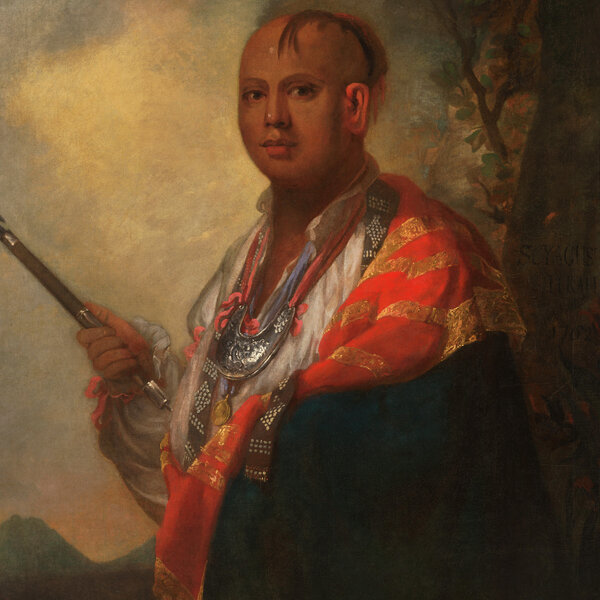
EPISODE 1
1. Facing Empire: A Long History of Representing Others
Bennelong, a Wangal man of the Eora nation, was among the first Aboriginal people to travel to Europe and return. As a crucial interlocutor between his people and the British colonists, he navigated two worlds but the way he was depicted in colonial portraits raises complex questions. In one, he appears in traditional body paint. In another, years later, he is dressed in European clothing, his identity seemingly reshaped for a colonial gaze. Do these portraits tell us more about Bennelong or the people who painted him?
Portraiture has long been a tool of empire, used to categorize, control, and mythologize. But can these images also reveal Indigenous agency? In this first episode, historians Kate Fullagar and Michael McDonnell visit the National Portrait Gallery to examine Bennelong’s likeness and trace a broader history of representation. They are joined by Anishinaabe writer Gordon Henry, who reflects on 17th-century depictions of Indigenous North Americans, and Cherokee scholar Joseph Pierce, who challenges the sanitized portrait of Cherokee diplomat Ostenaco.
Who really controls the stories that portraits tell? And how do these images continue to shape our understanding of Indigenous identity today? Join us on Unsettling Portraits to find out.
Episode Images
Drawing 41 from the Watling Collection titled ‘Native name Ben-nel-long, as painted when angry after Botany Bay Colebee was wounded.’ By Thomas Watling c 1790. Courtesy Natural History Museum London.
Portrait of a Famous One-eyed Man
By Louis Nicolas, 1675. Codex Canadensis, page 14. Courtesy Gilcrease Museum, Tulsa, Oklahoma USA.
Portrait of Syacust Ukah, Cherokee Chief
By Joshua Reynolds, 1762. Courtesy Gilcrease Museum, Tulsa, Oklahoma USA.
Hosts
Kate Fullagar, professor of history at the Australian Catholic University and Vice President of the Australian Historical Association, specializes in eighteenth-century world history, particularly the British Empire and Indigenous resistance. In her role at the AHA, she advocates for truth-telling in Australian historiography, working to integrate Indigenous perspectives and confront colonial legacies. Through works like Bennelong & Phillip, she engages both academic and general audiences, challenging traditional narratives.
Michael McDonnell, professor of Early American History at the University of Sydney, is currently working on several research projects with collaborators, including studies on comparative Indigenous experiences of empire, the American Revolution’s role in Black American life, and memoirs of lower-class Revolutionary War veterans. His work highlights the value of history in fostering diverse perspectives and uncovering new insights about both the past and present.
Guests
Gordon Henry is a member of the White Earth Anishinaabe Nation in Minnesota, USA and was professor of English at Michigan State University for 29 years. A widely published essayist, poet and fiction writer, he won the American Book Award for is novel The Light People. His creative work focuses on American Indian survival and adaptability, offering different Indigenous ways of relating to American history.
Joseph Pierce is a citizen of the Cherokee Nation and associate professor in the department of Hispanic Languages and Literature at Stony Brook University. His research focuses on the intersections of kinship, gender, sexuality, and race in Latin America, as well as culture, queer and Indigenous studies. Along with SJ Norman (Koori, Wiradjuri descent) he is co-curator of the performance series and indigenous-led gathering space Knowledge of Wounds.
To cite this episode
Fullagar, K (researcher and host), Freyne, C (producer), McDonnell, M (researcher and host), Thomas, H (producer) (2025), ‘Unsettling Portraits’ Episode 1. In History Lab by Impact Studios, https://impactstudios.edu.au/podcasts/history-lab/s6/ and 10.5281/zenodo.15086322

EPISODE 0
Introducing: Unsettling Portraits
Can colonial depictions of Indigenous people tell us anything useful about the past?
How do Indigenous people today feel about these enduring images?
Unsettling Portraits is a three-part series exploring the history of portraiture and colonialism, alongside contemporary First Nations responses.
Indigenous artists and historians in Australia, the Pacific and North America discuss the practice of colonial portraiture, including Daniel Browning, Jo Rey, Alice Te Punga Somerville, Gordon Henry and Joseph Pierce.
And you’ll hear about the ways in which contemporary artists like Daniel Boyd, Michel Tuffery, and the late Destiny Deacon have turned back the gaze on settlers with their art.
Join acclaimed historians Kate Fullagar (Australian Catholic University) and Mike McDonnell (Sydney University) as they wrestle with portraits of our colonial past in History Lab Season 6: Unsettling Portraits.
