Research and teach with Wikipedia: In the classroom and library
Episode Description
Every student uses Wikipedia. Some schools and teachers still tell them not to.
This episode asks why, and explains how to teach Wikipedia literacy to primary and secondary school students, instead of banning it outright.
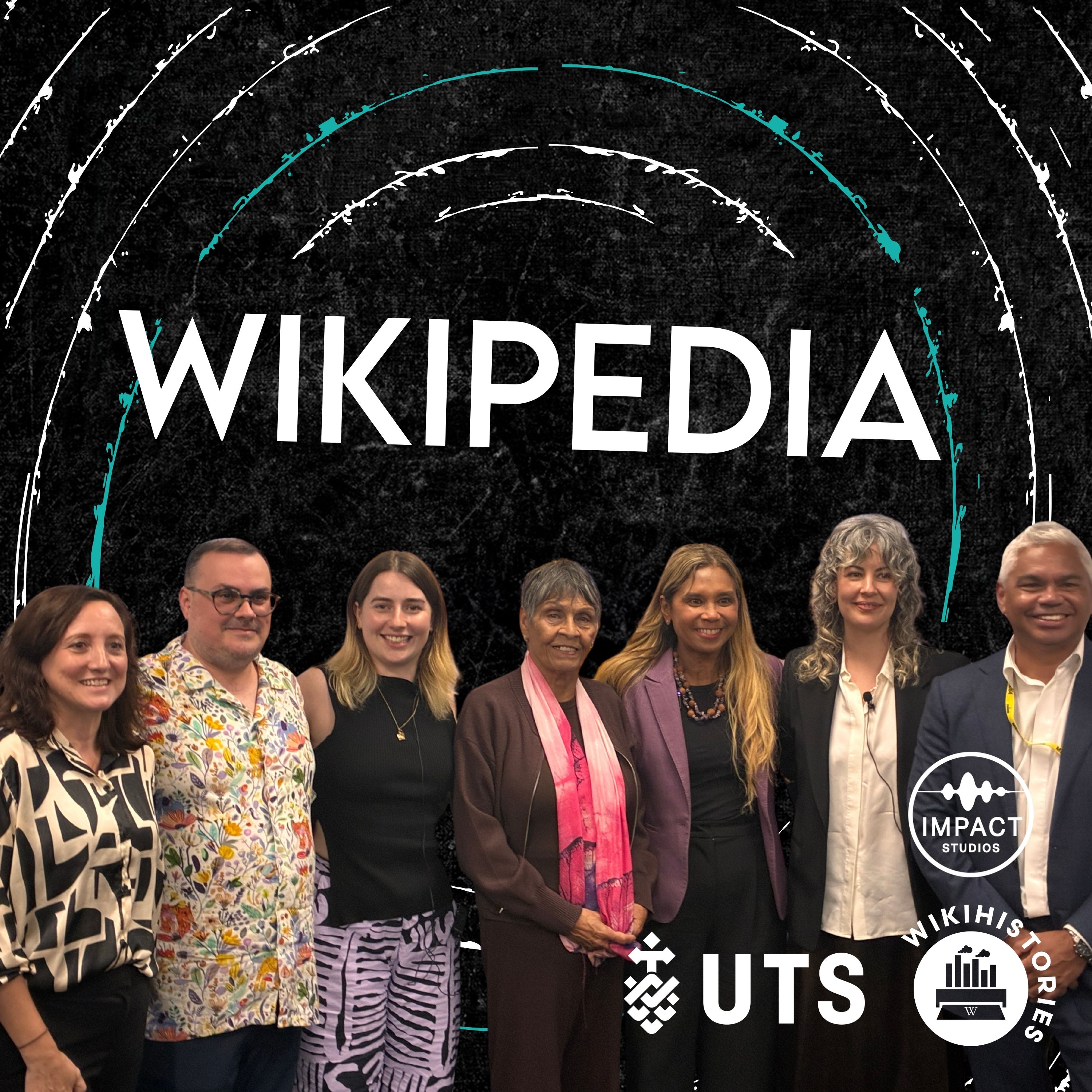
Researchers Heather Ford and Simon Knight answer questions and hear advice from teachers Ben Lawless, Marty Douglas and David Boon, and librarian Michelle Sadler.
Hear what good, critical Wikipedia use looks like in the classroom or library: questions to ask before even opening Wikipedia; checking the Talk page; and lateral reading.
Teachers: Using Wikipedia in the Classroom
A set of resources from the Wikimedia Foundation:
- Using Wikipedia to foster media and information literacy skills: Teachers Introductory booklet PDF (2020, 10 pages)
- Teachers’ Guide Module 1 PDF (2021, 72 pages)
- Teachers’ Guide Module 2 PDF (2021, 65 pages)
- Teachers’ Guide Module 3 PDF (2021, 56 pages)
- Reading Wikipedia in the Classroom (All languages) PDFs
Five Ways to Use Wikipedia in the Classroom
A Wikimedia blog post on how to integrate Wikipedia into classroom practice with:
- Source investigation
- Editing for accuracy
- Fact-Checking and Identifying Misinformation
- Neutral Point of View Practice
- Collaborative Editing
Students: Using Wikipedia in the Classroom
- A quick guide to using Wikipedia in a way that won’t make your teacher angry: Students Introductory booklet PDF (2020, 7 pages)
Checklist for how we verify claims: Card Catalog newletter
Echoing host Heather Ford’s advice in this episode, Hana Lee Goldin lists these verification techniques in her newsletter Card Catalog (September 2026):
- Search with intent
- Recognise document types
- Identify interests
- Trace provenance
- Read laterally
- Question what feels right
Read more about each of these in Hana Lee Goldin’s newsletter Card Catalogue: The Baseline Skill of the AI age.
WikiEdu For Instructors and their Students
WikiEdu is an accredited program run in the US and Canada. However, its resources are available for everyone.
In its flagship program, higher education instructors replace traditional assignments with the creation and improvement of Wikipedia articles.
In place of writing a traditional term paper, students take on a real-world assignment that requires them to identify reliable sources, evaluate evidence, and synthesize complex information for a public audience.
- crucial information for designing successful Wikipedia assignments.
- successful strategies for incorporating Wikipedia assignments
- engage in theoretical thinking around Wikipedia and knowledge production
- Editing Wikipedia
- Illustrating Wikipedia
- Evaluating Wikipedia
- topic-specific guidelines for contributors.
More reading
XKCD comic with ‘Citation needed’
- Original XKCD comic 285 Wikipedian Protester
- An explanation of XKCD comic 285 on the ‘explain xkcd’ wiki
Using Wikipedia in the University classroom
Authentic assessments: using Wikipedia in the University classroom (University of Sussex blog, 2022): The Educational Enhancement Team at the University of Sussex, UK, on how many of their academic Schools and Departments are looking at how they can add more authentic assessments to their modules – including Wikipedia assessments.
Comparing Wikipedia, encyclopedias and AI
Comparing Wikipedia, Traditional Encyclopedias, and Generative AI: The Wikipedia Assignment as Tool for Student Information Literacies (WikiEd blog, 2025): Professor Katie Hold had students compare a traditional encyclopedia, a Wikipedia article, and a generative AI query on their research topics as an information-literacy exercise. Students grew more appreciative of Wikipedia’s verifiable sourcing, while criticizing AI outputs for inaccuracies, broken citations, and closely mirroring Wikipedia without attribution. The exercise reinforced that all three sources work best as starting points for further research, not endpoints.
Research
Wikipedia no worse for science info than Britannica, study finds (The Guardian, 2005)
Internet encyclopaedias go head to head by Jim Giles (Nature, 2005)
Voices
Heather Ford is an ARC Future Fellow and Professor in the School of Communication and Social Sciences at UTS. She is a former Advisory Board member of the Wikimedia Foundation and the author of “Writing the Revolution: Wikipedia and the Survival of Facts in the Digital Age” published by MIT Press.
Simon Knight is a member of the University of Technology Sydney Centre for Research on Education in a Digital Society (UTS: CREDS), and its founding Director. Dr Knight researches how people learn to navigate uncertainty, disagreement, and evidence, and the mediating role of technology in that.
Credits
The executive producer of this series is Heather Ford.
The series is hosted by Heather Ford, Francesca Sidoti and Richard Cooke.
Produced by Jane Curtis. Associate producer is Francesa Sidoti.
Sound by John Jacobs.
Executive Producer of UTS Impact Studios is Sarah Gilbert.
It’s produced on Gadigal Country in Sydney Australia.
wikihistories is supported by Australian Research Council Grant DP220100662, ‘Wikipedia and the Nation’s Story: Towards Equity in Knowledge Production’.
Find out more at wikihistories.net